Loading...
elearning Campus BlogWhat are Mammals
What are Mammals
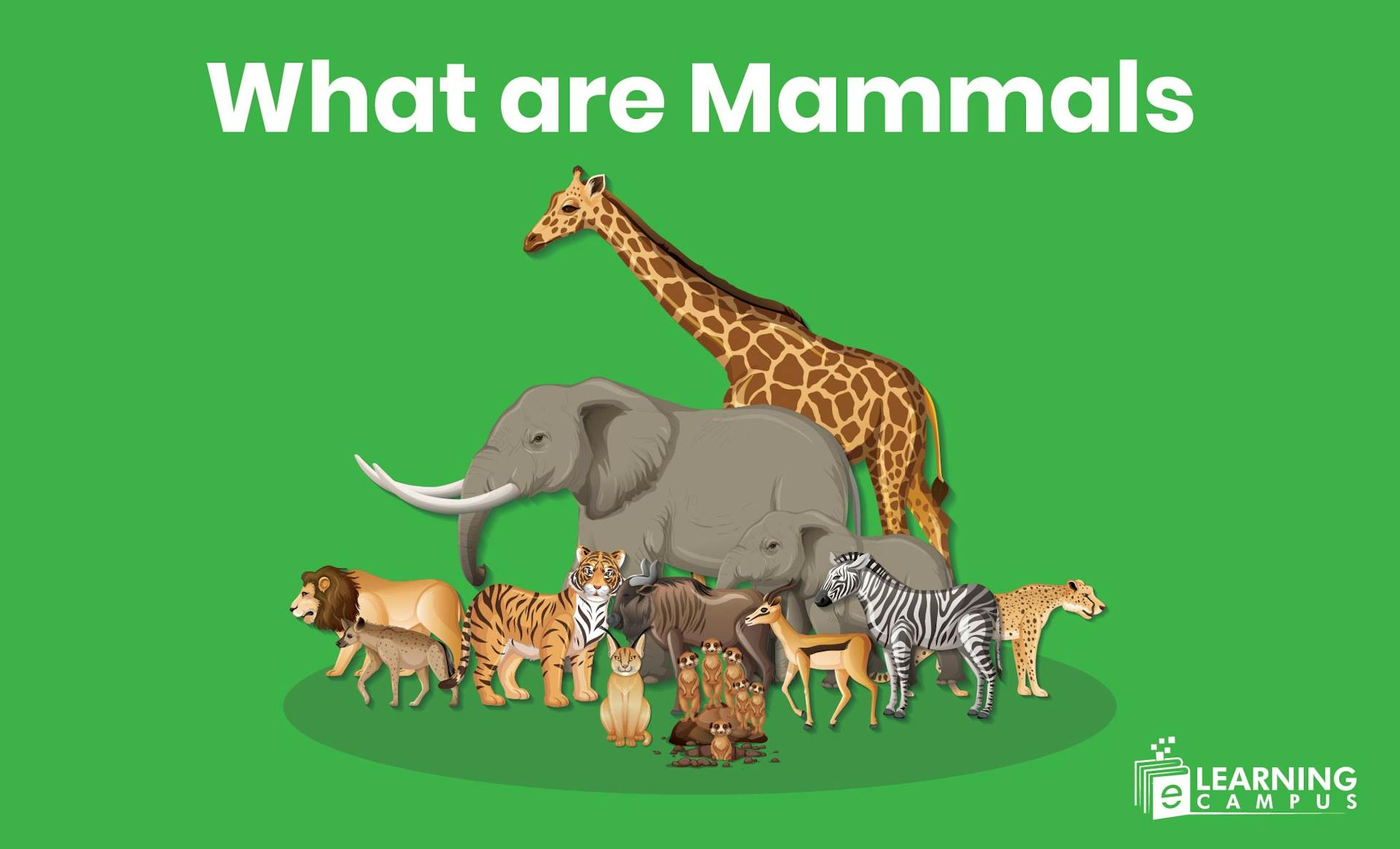
Have you ever wondered what mammals are and what makes them different from other animals? Mammals are one of the most familiar groups of animals on earth, which have hair on their bodies, give live birth, and feed their child with milk produced by their mammary glands. It includes humans, dogs, cats, whales, bats, and many more.
In this blog, we provide details on what mammals are, their main attributes, their types, and how they survive in cold climates.
What are Mammals
A mammal is a warm-blooded vertebrate animal that belongs to the class Mammalia, which has three key features;
- Female Mammals have mammary glands to feed their young ones.
- They have hair or fur on some part of the body.
- Mammals do not give eggs; they give live birth(except few, like the platypus and echidna, that lay eggs.
What are the Attributes that Make Mammal a mammal?
Mammals are a special group of animals with unique features that set them apart from reptiles, amphibians, birds, and fish. Here are the main characteristics of mammals explained in detail.
Mammary glands
This is one of the main attributes of mammals that makes them different from amphibians and reptiles. Female mammals produce milk from their mammary glands. The young depend on milk for early growth and immunity. This creates a strong bond between mother and baby.
- For example;
- A cow feeding her calf
- A cat feeding kittens
- A human mother breastfeeding a baby
Hair or Fur
Another key feature of mammals is hair or fur. Even if it is very small or temporary (like in whales or dolphins), all mammals have hair at some stage of life. Hair helps mammals by;
- Keeping the body warm
- Protecting the skin
- Helping with camouflage
- Acting as a sensory organ(like a cat, whiskers)
Warm-blooded
Mammals are warm-blooded animals. It means that they maintain a constant body temperature that stays almost the same no matter the weather. They can survive in;
- Freezing polar region
- Hot deserts
- Tropical forests
- Deep oceans
Breathe through the lungs
All mammals breathe using lungs; even marine mammals such as whales, Dolphins, or seals must come to the surface to breathe air. They cannot breathe underwater like fish; that’s why whales come up to exhale or inhale.
Mammals Have a Backbone
Mammals belong to the vertebrate group. This protects the spinal cord and helps the body, movement, for example, humans, Dogs, horses, lions, etc.
Give Birth to live young
Most mammals do not lay eggs; instead, they give live birth to their babies. This is also a major difference that makes mammals different from amphibians or reptiles.
Well-developed Brains
Mammals have more advanced brains than most other animals. This allows them to learn, remember, solve problems, show emotions, or communicate. Humans are the most advanced mammals intellectually, but animals like dolphins, elephants, and chimpanzees are also highly intelligent.
Specialized Teeth
Their teeth help them to eat various foods such as meat, plants, or both. They have different types of teeth for different functions:
- Incisors -cutting
- Canines -tearing
- Molars -grinding
Heart
Mammals have -four-chambered heart, which ensures efficient blood circulation and supports high activity levels. This is also found in birds, but not in reptiles or amphibians.
Types of Mammals
There are three main kinds of mammals based on how they reproduce.
- Placental Mammals
- Marsupials
- Monotremes
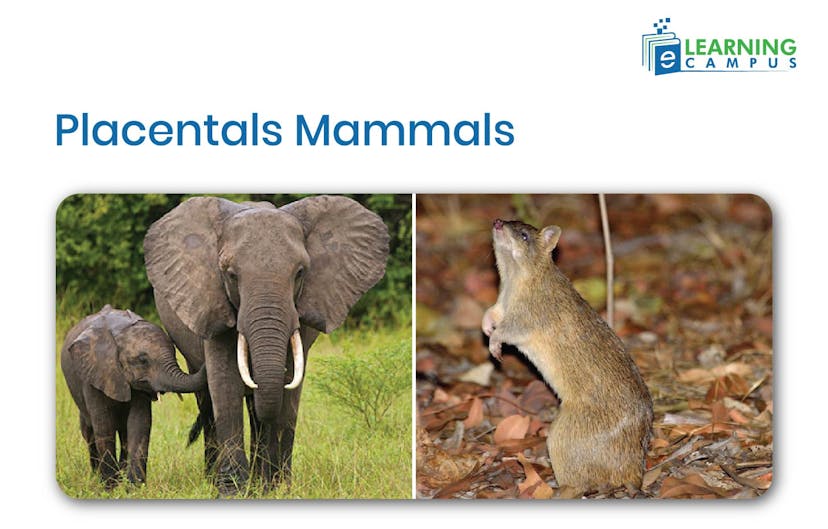
Placentals Mammals
Placentals make up over 90% of all Mammals. This is the largest group. Babies develop inside the mother’s womb and are nourished by the placenta until birth. They have a long pregnancy. Young are more fully developed at birth.
For Example,
Humans, elephants, monkeys, dogs, cats, bats, etc.
Marsupials
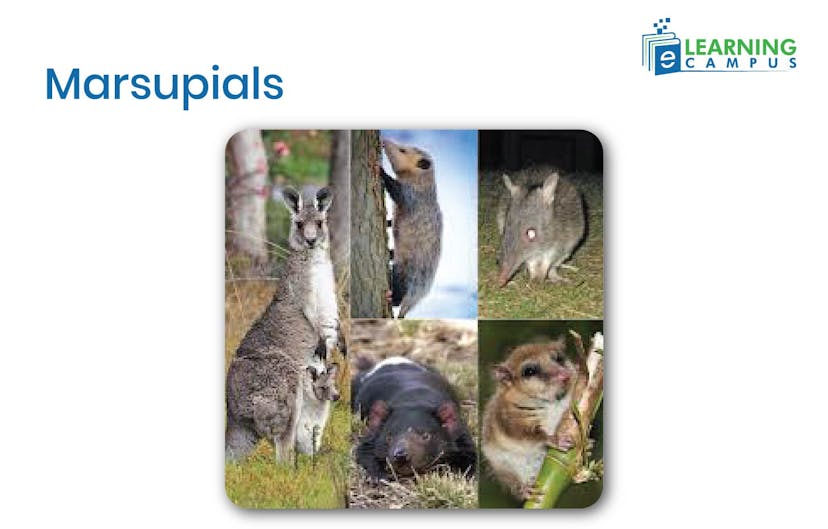
Marsupial babies are born very tiny and undeveloped. They crawl into the pouch on the mother,s belly to continue growing. They have a short pregnancy. Baby develops in a pouch.
For Example;
Kangaroo, koala, opossum, etc
Monotremes (egg-laying mammals)
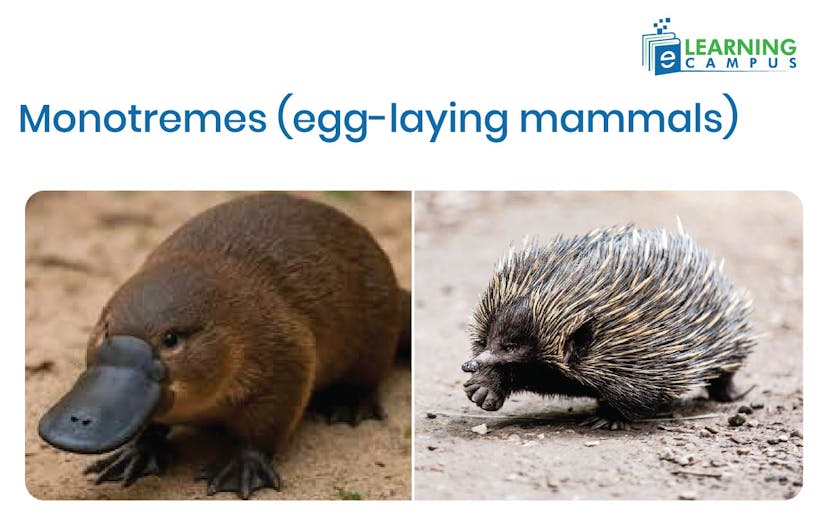
They are the oldest and rarest group of mammals. These are the only mammals that lay eggs instead of giving birth to live young. They lay soft-shelled eggs. They have beaks instead of teeth. Babies are fed milk, which is released through the skin.
For Example
Platypus, short-beaked echidna, or long-beaked echidna, etc.
Classification of Mammals
Apart from reproduction, mammals can also be classified based on habitat and diet.
Land mammals: These are the mammals that live mainly on land. Some may be able to swim or climb, but their main habitat is the ground. For example, lion, elephant, wolves, rabbit, etc.
Water mammals (Aquatic): These are the mammals that live in water but still breathe air. For example, whales, dolphins manatees.
Tree-dwelling Mammals: These mammals spend most of their lives in trees.For example, Monkeys, sloths, and squirrels.
Adaptations of Mammals
Mammals are one of the successful groups of animals on Earth. They live in oceans, fires, mountains, deserts, ice lands, caves, and even cities. The mammals can survive in such different environments because of their adaptations. Let’s explore these adaptations in detail;
Adaptation to Cold Climates
Mammals in cold places like the Arctic have:
- Thick fur or hair, e.g, polar bears, Arctic foxes
- Layer of fat (blubber), e.g, seals and whales
- Small ears and limbs to reduce loss
- Hibernation, such as bears, involves sleeping during winter to save energy.
Adaptation to Hot Climates
Mammals in deserts or hot regions may have;
- thin fur or little hair, e.g, elephants
- Large ears for heat loss, e.g, African elephants, fennec fox.
- Nocturnal habits, which means being active at night when it's cooler
- Ability to store water or conserve it, e.g, camels.
Body covering
Hair or fur is a key mammal feature. It helps with warmth, camouflage, and protection.
For example;
- Zebra stripes confuse predators
- Snow leopard blends with snowy rocks
- Porcupines have spines for defense.
Respiratory and Circulatory Adaptations
Mammals have large lungs and strong hearts to support active lifestyles.
- Marine mammals such as whales and dolphins store oxygen in their muscles, slow their heartbeat underwater, and can hold their breath for long periods.
- Land mammals such as cheetahs and horses have powerful hearts and rapid breathing ability so they can run fast or long distances.
Teeth Adaptation
Herbivores have flat teeth for grinding plants. Carnivores have sharp teeth for tearing meat. Omnivores have both types of teeth.
Reproductive Adaptations
Babies are fed milk from their mother. Some grow in a pouch (kangaroos), and others inside the womb.
Interesting facts about Mammals
Here are some interesting facts about mammals:
- Humans are mammals, sharing hair,milk-feeding, and warm-blooded traits.
- The blue whale is the largest mammal, reaching up to 30 meters and weighing 200 tons.
- The bumblebee bat is the smallest mammal, weighing only 2 grams.
- Bats are the only mammals that can fly.
- Elephants have incredible memory, remembering water sources and migration routes.
- Mammals communicate in unique ways, such as dolphins use clicks and whistles, elephants use low-frequency sounds, and bats use echolocation.
- Some mammals have highly developed senses, such as dogs that smell 50 times better than humans, and cats that see in low light.
Conclusion
Mammals are one of the most diverse and successful groups of animals on Earth. Humans are also mammals. From tiny bats to giant whales, they have adapted to almost every environment. They have a warm-blooded nature, hair on body and the ability of mothers to feed their young with milk. These features make them distinct from reptiles and amphibians.
Learn science online with Expert Tutors
Are you struggling with science subjects? We can help you. Our online science tutors guide you in learning. You will get one-on-one online tutoring for science lessons and exam preparations. Get benefits with our online tutoring service and boost your knowledge and grades in Science now!