How to Simplify Absolute Value Expressions with Variables
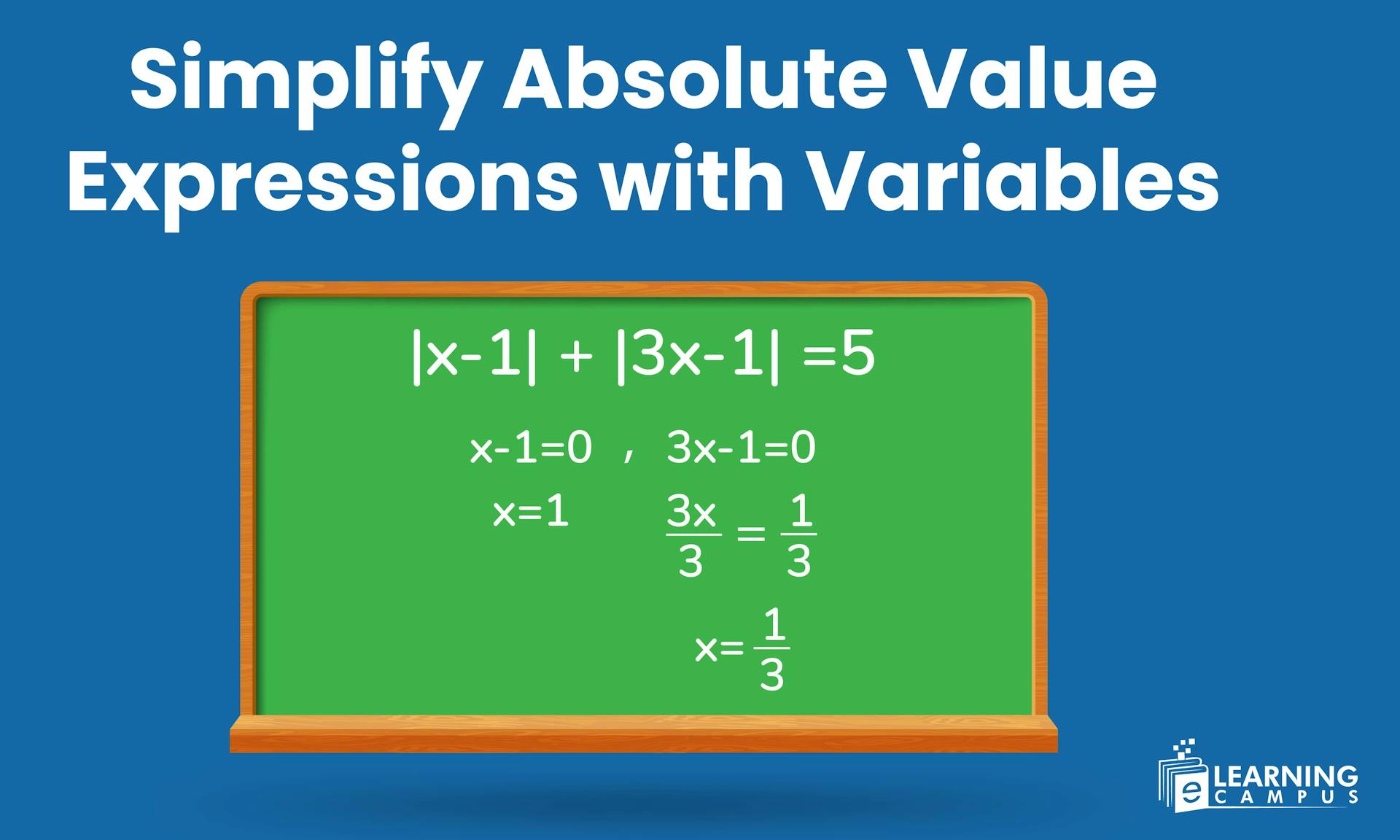
Have you ever seen an expression like |x-3|,|2a+5|, or wondered how to simplify an absolute value expression with variables? Absolute value is the distance from the zero line, and it can always be non-negative.
This guide explains simplifying absolute value expressions, how to remove absolute value, and how to express quantities without using absolute value step by step in detail.
What is An Absolute Value?
The Absolute value of a number is its distance from zero on the number line.
Because distance is never negative. So, the Absolute value of any number is always positive
For Example ;
- Positive stays positive |6|=6
- Negative values become positive, ignoring the negative sign |-6|=6
- Zero stays zero.|0|=0
The absolute value always gives a non-negative number because it measures distance from zero.
Rules to Simplify an Absolute Value Expression with Variables
There are some rules that are used to simplify an absolute value expression with variables. Here are some rules that you need to know for easy understanding.
Rule 01: Absolute value is never negative
The result of an absolute value is always zero or positive. For example, |x| ≥ 0 for all real x.
Rule 02: The expression inside is always positive
If the variable expression is always positive, you can remove the absolute value sign directly.
Rule 03: Use case method for variables
When the sign of the expression is unknown, use cases.
Example: Simplify |x-4|
Case 01: x - 4 ≥ 0 (x ≥ 4)
|x - 4| = x - 4
Case 02: x - 4 < 0 (x < 4)
|x - 4| = -(x - 4) = -x + 4
Final Answer:
|x - 4| = {
x - 4, if x ≥ 4
-x + 4, if x < 4
}
How to Simplify an Absolute Value Step-by-Step Method
To simplify an absolute value, you need to identify the expression inside bars, set up an inequality, write both cases, and simplify your answer. Here are the steps;
Step 01: Identify the Expression
See what is inside the absolute value bars.
e.g;
|2x-3|
Step 02: Set up Inequalities
Finds when the inside expression is positive or negative.
2x-3 ≥ 0 → x ≥ 3/2
2x-3 < 0 → x < 3/2
Step 03: Write both cases
Case 01: If x ≥ 3/2
|2x-3| = 2x-3
Case 02: If x < 3/2
|2x-3| = -(2x-3) = -2x+3
Step 04: Combine the final Answer
|2x-3| = {
2x-3, if x ≥ 3/2
-2x+3, if x < 3/2
}
How to Remove Absolute Value?
Removing absolute means rewriting an expression without | | signs. Since absolute value depends on whether the inside expression is positive or negative, we remove it using cases.
General Rule:
For any expression A:
|A| = A, If A ≥ 0
|A| = -A, If A < 0
This rule works for numbers, variables, and algebraic expressions.
Step to Remove Absolute Value
Step 01: Let the inside expression be A:
Example |x-3|
Step 02: Find where the expression is zero
x-3 = 0 gives x = 3
Step 03: Write cases
When x ≥ 3, x-3 ≥ 0
When x < 3, x-3 < 0
Step 04: Remove | | using piecewise form
|x-3| = {
x-3, x ≥ 3
-(x-3), x < 3
}
How Do You Find the Absolute Value of a Fraction
The absolute value of a fraction tells us how far the fraction is from zero on the number line. It removes the negative sign but keeps the number’s size the same.
For any fraction a/b = |a| / |b|
Absolute value shows the distance from zero; the distance is positive, so the fraction left of zero becomes positive. For example:
-3/7 = 3/7
Let's find the absolute value of a fraction with different aspects. Here are the steps:
Step 01: Check the sign of the fraction
- If the fraction is positive, then keep it
- If the fraction is negative, then remove the minus signs.
Step 02: Write the result as a positive fraction
You need to write a fraction as positive. Whether the negative sign comes with the numerator, denominator, or both, you just remove the negative sign and write them as a positive fraction.
For Example 01:
|2/3| = 2/3
It is already positive
Example 02: Fraction with a negative value
|-7/4| = 7/4
Example 03: Negative sign in the numerator
|-2/3| = 2/3
Example 04: Negative sign in the denominator
|2/-3| = 2/3
Example 05: Negative sign in numerator and denominator
|-2/-3| = 2/3
How to Simplify the Absolute Value Radicals
When simplifying the radicals with variables, people often get confused, especially when absolute values appear. The main reason is that square roots are always non-negative, while variables inside may be positive or negative. Here are the steps ;
Let’s solve √4(x+1)²
Step 01: Split the radical
√4 · (x+1)²
Step 02: Take square roots
√4 = 2
√(x+1)² = |x+1| (absolute value is needed becuse x+1 can be negative)
Step 03: Multiply
√4(x+1)² = 2|x+1|
√x² = |x|
Rules need to be remembered while simplifying the Absolute value Radicals
The absolute value is only needed for variables, but positive numbers.
If a variable is stated as positive, the absolute value can be removed.
The square root of a square is the absolute value.
E.g. √(5)² = √25 = √5 = |-5|
For plain numbers that are perfect squares, the square root is always positive.
E.g. √9 = 3 which is already positive, so no absolute value is required.
Conclusion
Simplifying absolute value expressions with variables becomes easy once you understand the idea of case. The absolute value of a number tells the distance from zero, which can never be negative. So, the absolute value is always positive. To simplify correctly, first find where the expression inside the absolute value equals zero, then split the problem into two cases. With regular practice, absolute value expressions with variables become straightforward and manageable.
Learn Math online with Expert Tutors
Want to Learn interesting math concepts like simplifying absolute value expressions with variables? Don't worry, our expert online math tutors can help you build your key concepts. They will help with your homework, preparation for exams, and build basic math concepts. Get benefits with our online tutoring service now.